JOHANNA FUSCO — TEXTILE ARTIST
Cartographies de l’Invisible
Abstract textile works handwoven from natural fibres and botanical dyes, born from an inquiry into the ways we come to think of ourselves as separate from the world.
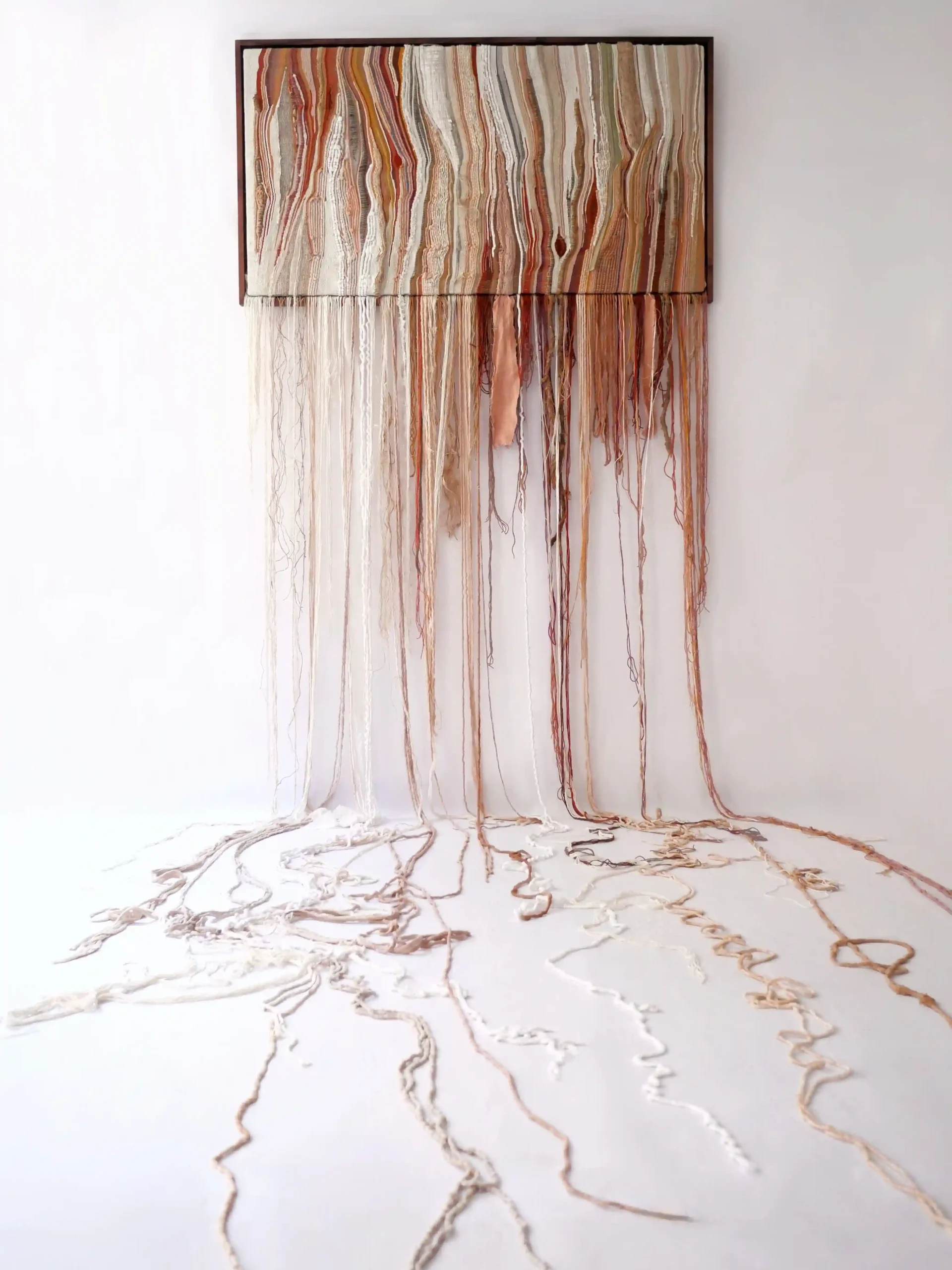
We do not stand outside the world.
To understand the world, we draw boundaries. We name species, distinguish environments, divide time into periods, and separate an observer from what is being observed. These operations make differences perceptible and allow us to build knowledge.
What concerns me is the moment when these necessary boundaries cease to function as tools and become, in the ways we perceive and act, closures imposed upon reality.
My practice emerges from this gap: how can we know precisely what we are part of without imagining ourselves outside it?
À travers le tissage, les fibres naturelles et les teintures végétales, je cherche une forme qui puisse tenir ensemble ce que nous distinguons sans le penser comme séparé.
Through weaving, natural fibres and botanical dyes, I seek a form that can hold together what we distinguish without treating it as separate.
RECENT WORKS
My works do not represent landscapes, ecosystems or invisible networks.
I construct abstract surfaces shaped by tensions, intervals, overlaps and openings. Contours exist without necessarily becoming sealed boundaries; threads can enter the surface, emerge from it, or continue their movement beyond the frame.
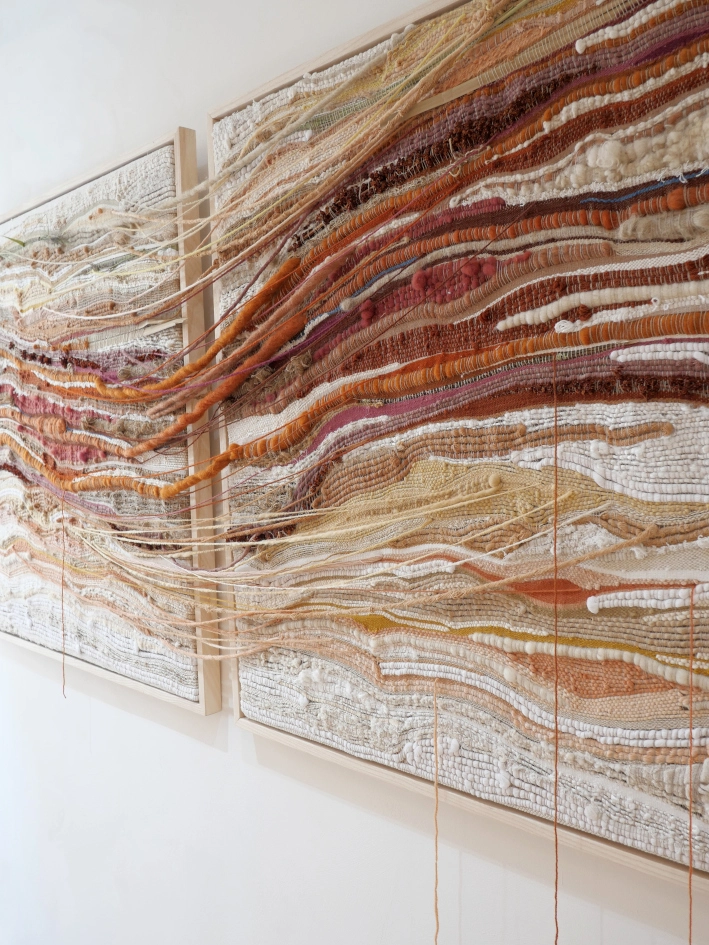
Cartographies de l’Invisible #13
2026 · 183 × 88 cm
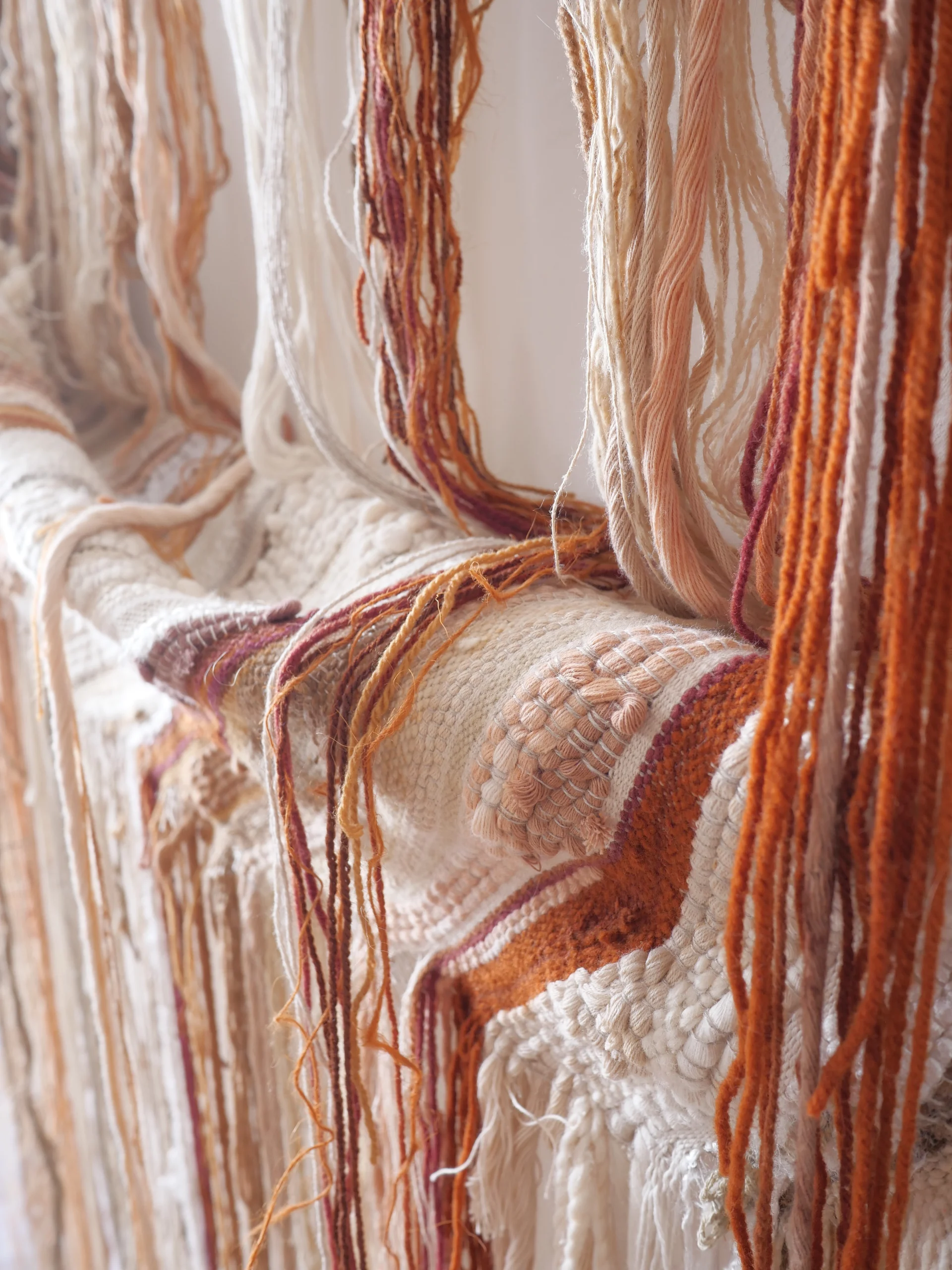
Cartographies de l’Invisible #15
2026 · 130 × 200 × 80 cm
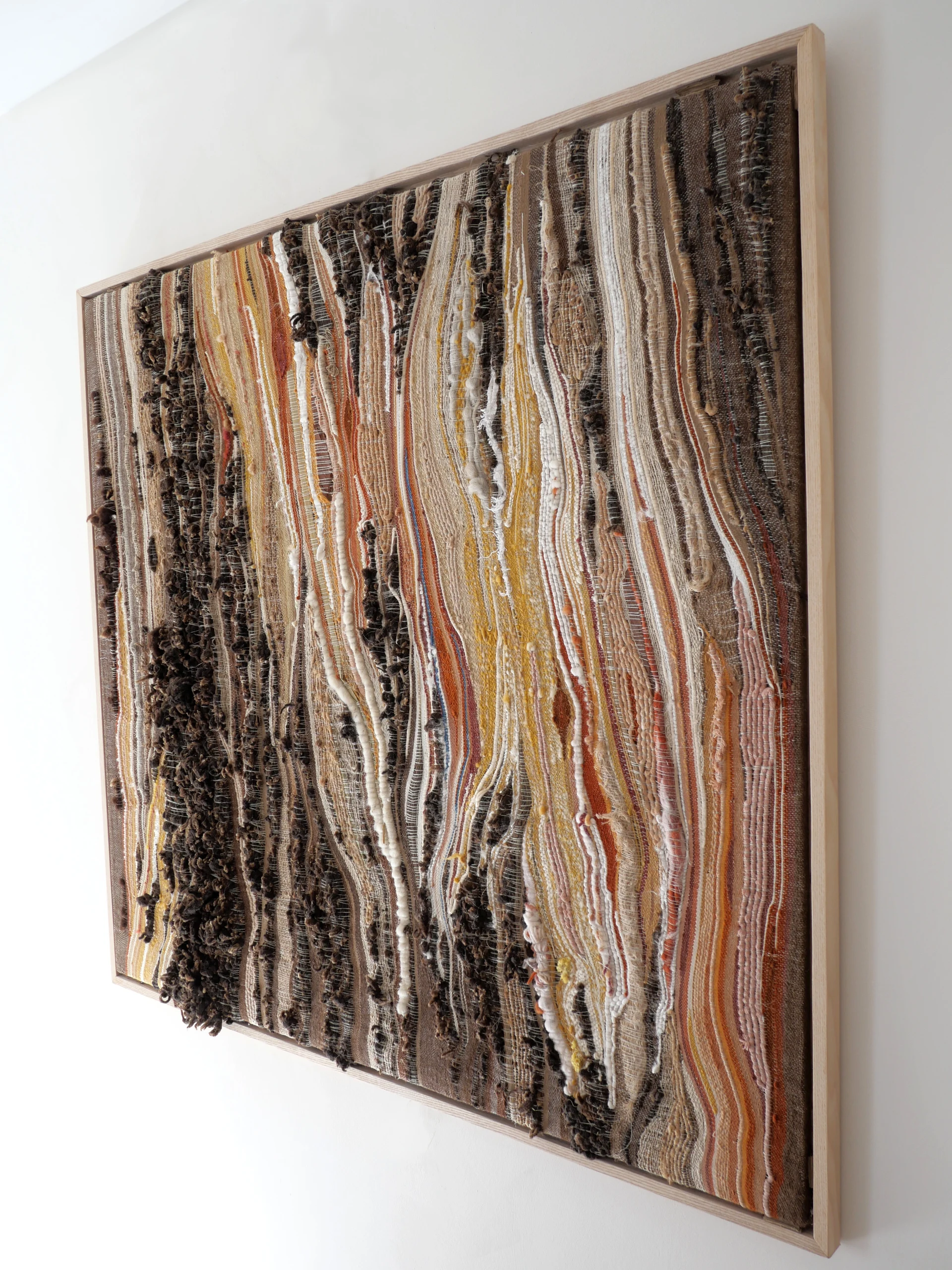
Cartographies de l’Invisible #12
2026 · 118 × 125 cm
MATTER
Grounding abstraction.
I never work with “matter” in the abstract.
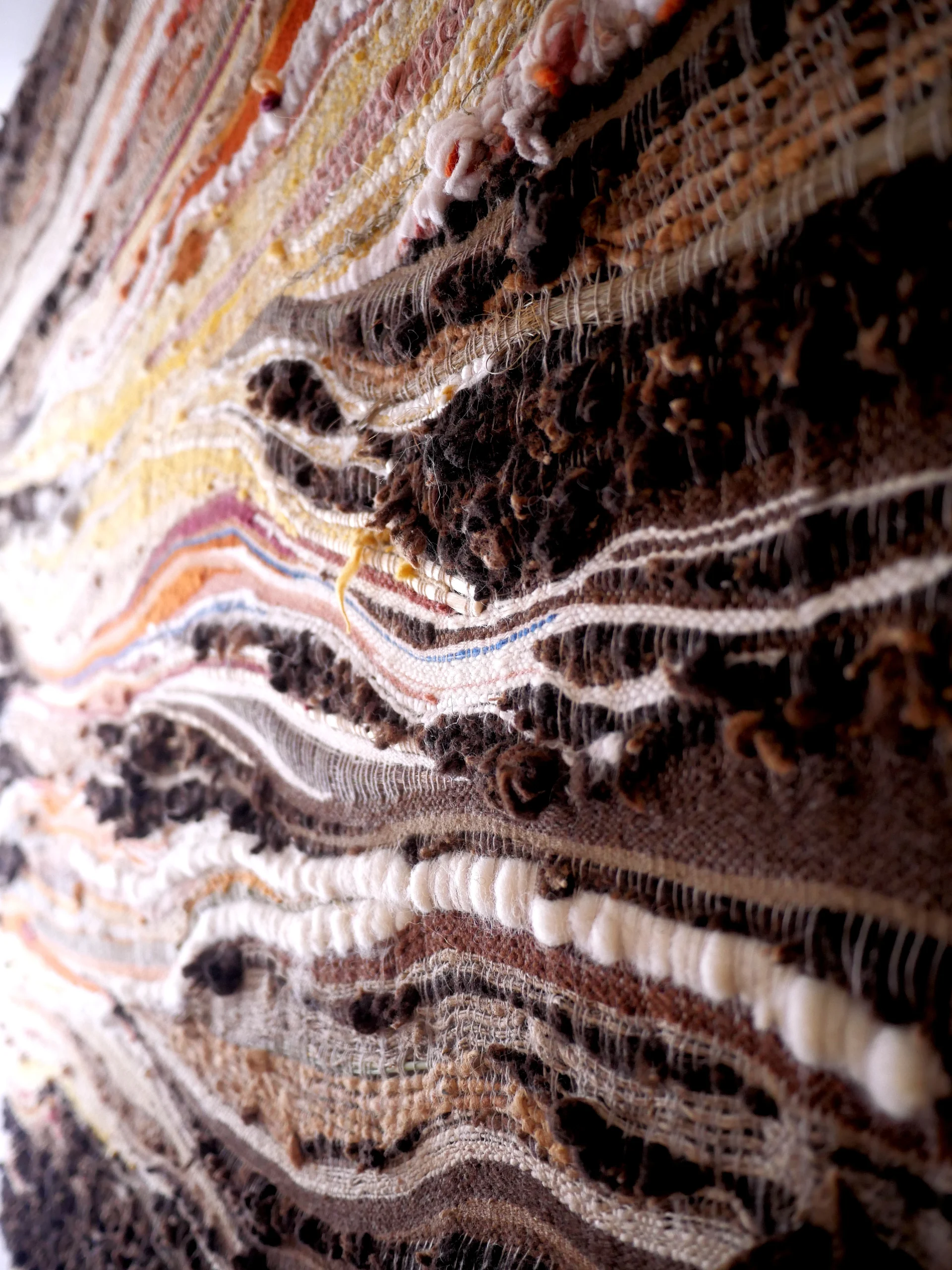
A fibre has an origin, a structure and a behaviour. A colour depends on a plant, water, temperature and time. Soil carries a geological history; wood bears the history of its growth and environment.
This precise knowledge fascinates me. But the work does not become an account of it: a fibre does not represent the being or territory it comes from, any more than a colour tells the story of the plant that produced it.
I begin with what can be precisely named in order to construct a form that is no longer required to represent that name.

THE FRAME AS THRESHOLD
How can a boundary give form without becoming a closure?
Weaving interests me because the relations that compose the surface are material realities: threads cross, stretch and separate; air and light pass between them; a cut can alter the way the whole structure holds together.
The frame also acts materially. It gives the surface form, tension and scale. But it does not always constitute its final boundary: some threads cross it or continue their movement into space.
A singular form can be distinct without being isolated. A boundary can define without becoming a wall.
FROM GEOGRAPHY TO TEXTILE
I never stopped researching.
I changed the conditions of that research.
Before becoming an artist, I was a geographer, lecturer and researcher. Science shaped the way I look: observing closely, distinguishing, documenting, and understanding the relationships that shape a landscape.
I have not abandoned this way of knowing. But I needed a space where thought could also engage the body, the hand, duration and matter.
Art became another form of inquiry for me.
Exhibitions & News
AWARD · 2026
Valcellina Award — Silver Medal
2nd Prize · 12th edition “Wake up!” · Le Arti Tessili · Maniago, Italy
UPCOMING
10—13 SEPTEMBER 2026
Oh My Laine! — Paris Design Week
Galerie Joseph · Paris
22—25 OCTOBER 2026
Carpet Diem Paris
Espace Commines · Paris
19—23 MAY 2027
Révélations
Grand Palais · Paris
SITE-SPECIFIC WORKS
A work can begin with a place.
Some Cartographies de l’Invisible are created for a particular place. Its dimensions, use, installation constraints, and sometimes its history or the territory to which it belongs can become part of the conditions from which I work.
The aim is not to adapt a motif or decorative language to an interior, but to allow a work to emerge from certain conditions specific to the place, while continuing the same inquiry that runs through the rest of my practice.