FROM GEOGRAPHY TO TEXTILE
For a long time, I sought to understand landscapes.
Then I wanted to understand what it means to belong to them.
Before becoming an artist, I was a geographer and researcher. I studied landscapes, biodiversity and the relationships between human societies and their environments, seeking to understand how the visible forms of a territory emerge from relationships that are far less visible.
Research taught me to observe, describe, measure and question. Above all, it taught me to look beyond seemingly isolated things for the systems of relations that make them possible.
I have not abandoned this way of looking. But gradually, I began to feel the gap between knowing the relations that compose a world and actually feeling myself embedded within them.
learning to look
Landscape has never been a backdrop to me.
In geography, I learned to read a landscape as the provisional outcome of countless histories and relations. A landform, a hedge, a field, the presence or absence of a species, an agricultural practice: none of these exists in isolation.
In the field as in research, I had to learn to move constantly from what could be seen to what had made it possible: physical processes, human practices, flows, inherited structures, and transformations that could be slow or sometimes abrupt.
I taught landscape analysis and spent several years researching the relationships between land use and biodiversity. This experience profoundly shaped the way I think: what exists never exists alone.
Looking at a landscape already meant trying to make perceptible relations that are not immediately visible.

BROADENING THE INQUIRY
Knowing without standing outside.
Over the course of my years in research, one question became increasingly present. The knowledge we build allows us to describe environments, species and transformations of landscapes with great precision. I deeply value this way of knowing, and it remains present in my work.
But knowing also requires us to name, distinguish and divide. These operations are necessary to make reality intelligible. What concerns me is the moment when we forget that they are tools, and the boundaries they draw begin to make us think of what they distinguish as separate.
I was therefore not seeking to leave reason behind in favour of sensation. I needed to broaden the conditions of inquiry: to find a space where the body, the hand, time and matter could also participate in what I was trying to understand.
I did not want to understand less. I needed not to remain outside what I was trying to understand.
ENTERING INTO MATTER
Making taught me something I could not arrive at through thought alone.
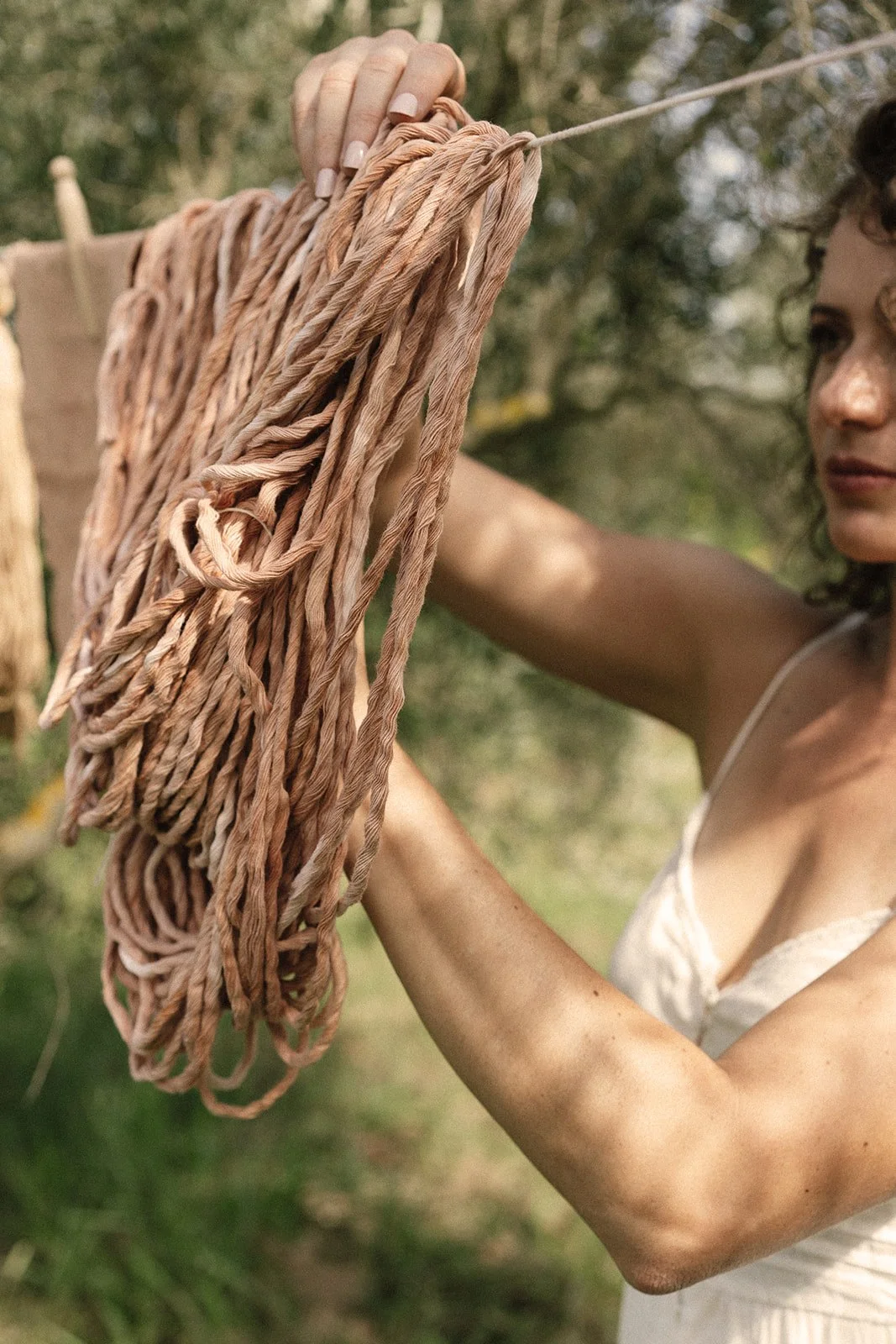
Textile entered my life through making. I learned to spin, dye, weave, prepare fibres and build frames. These are very concrete gestures that require time, precision and sustained attention to what is actually happening under the hands.
There I encountered another mode of knowing, one that does not replace the one I had been trained in. A fibre cannot be reduced to its described properties: its resistance, flexibility and tension have to be experienced; one has to observe how it responds to water, twisting or another material. Each decision changes what becomes possible next.
The body, the hand and time also become instruments of inquiry.
Gradually, these gestures ceased to be simply ways of making objects. They became a way of working through the question that had stayed with me since my years in research: how can we think a world made of relations without continuing to place ourselves outside it?
Textile did not give me an answer. It gave me a place from which to search differently.
today
The studio as a site of inquiry
Today, my work continues in the Sauvage & Beau studio in Provence.
There, I spin, dye, weave, assemble, build frames, observe materials and begin again. The tools have changed since my years in research, but certain habits remain: looking closely and at length, documenting, comparing, understanding what is happening, and questioning a hypothesis when what emerges contradicts it.
In my work, I do not really separate the time of thinking from the time of making. A question can arise from a reading just as it can from the unexpected behaviour of a fibre; a form can alter what I thought I understood; a material can compel me to reconsider a decision.
This is how the Cartographies de l’Invisible gradually take shape: not as the application of a theory to form, but as successive states of an inquiry conducted through matter.
I never stopped researching. I changed the conditions of that research.

biography
Practical information
2016
PhD in geography
Université Nice Sophia Antipolis
2011—2019
University Teaching
Université Nice Sophia Antipolis
2016—2022
Research in Geography
Landscapes · biodiversity · land use / INRAE · CNRS
2025
Founding of Sauvage & Beau
Artist studio · Provence
2025—TODAY
artistic practice
Cartographies de l’Invisible · Contemporary textile art