practice
I do not seek to represent the world.
Creating has become a way for me to explore the gap between what I can know about the world and how I can feel myself to be part of what I know.
My background is in geography and scientific research. I retain from it a deep appreciation for precision, observation and the distinctions that allow us to make reality intelligible. But I question the moment when these necessary boundaries cease to be tools and become, in our imaginaries and ways of acting, closures imposed upon reality.
In a world still largely organised as though the living world were an external realm available to us, this way of perceiving boundaries is not an abstract question for me.
My works offer neither solutions nor directives.
I work at a more subtle level: where the ways we perceive already shape, in part, the ways we act.
abstraction
Grounding abstraction
I never work with “matter” in the abstract. A fibre, a colour, a soil or a wood has its own origin, structure, properties and temporalities.
This precision fascinates me. The more I learn, the less generic the living world appears.
But the work is not an account of this knowledge. A colour does not tell the story of the plant it comes from. A fibre represents neither the being nor the territory that produced it.
I begin with what can be precisely named in order to construct a form that is no longer required to represent that name.
My abstraction is not a withdrawal from reality. It becomes possible through this grounding.
materials
There is no such thing as “matter” in general.
I work with a wide range of natural fibres: wools from different breeds and territories, flax, hemp, nettle, cotton, silk and foraged plant fibres, as well as soils, woods, dye plants and fungi.
As far as possible, I seek to understand their origins, the conditions in which they were produced and the transformations they have undergone. Wool is never simply “wool”: its length, fineness, crimp, loft and response to dye vary according to the animal, the breed, the environment and the processes used to prepare it. Plant fibres likewise have their own structures, resistances and possibilities.
Some materials are gathered from the landscapes around me; others come from producers, breeders or supply chains whose origins I can trace. This knowledge does not turn matter into a symbol. On the contrary, it allows me to encounter it in its singularity.
A material can also carry several temporalities at once. A work brings together the growth of a plant or a fleece, the history of a soil, the season of a harvest, the duration of a dye bath, the hours of making, and the future ageing of fibres and colours. The date on the label tells only part of this story.
My choice of materials follows from this attention: natural fibres, botanical dyes without metal mordants, dye baths used to exhaustion, residues composted whenever their nature allows it, and woods sourced as locally as possible.
The more precisely I come to know a material, the less it appears to me as an anonymous resource. Through sustained contact with it, it also transforms what I become capable of noticing.
WORKING WITH
Mastering enough to listen.
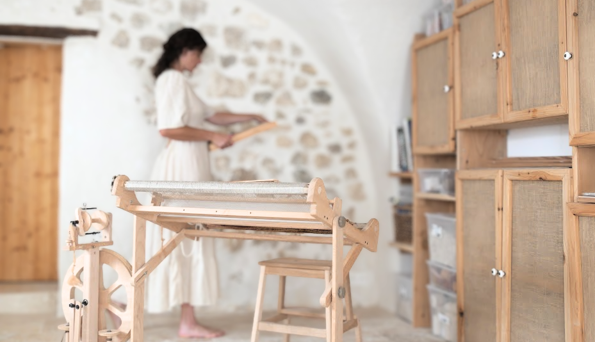
Spinning, dyeing and weaving require technique, anticipation and many decisions. I work with a direction, sometimes with a very precise structure, but a work also passes through a succession of processes whose consequences I cannot entirely determine.

Thought leads to gesture; gesture, in turn, transforms thought.

A fibre has its own resistance, flexibility and elasticity. A dye responds to water, temperature, time and the material that receives it. Spinning alters the material; the tensions of weaving, in turn, transform what becomes possible.
Working with these materials means acting upon them, but also observing what my gestures produce and allowing this new situation to influence what follows.
I seek neither to impose a fully predetermined form nor to leave the work to chance.
WHY WEAVING
A structure of relations.
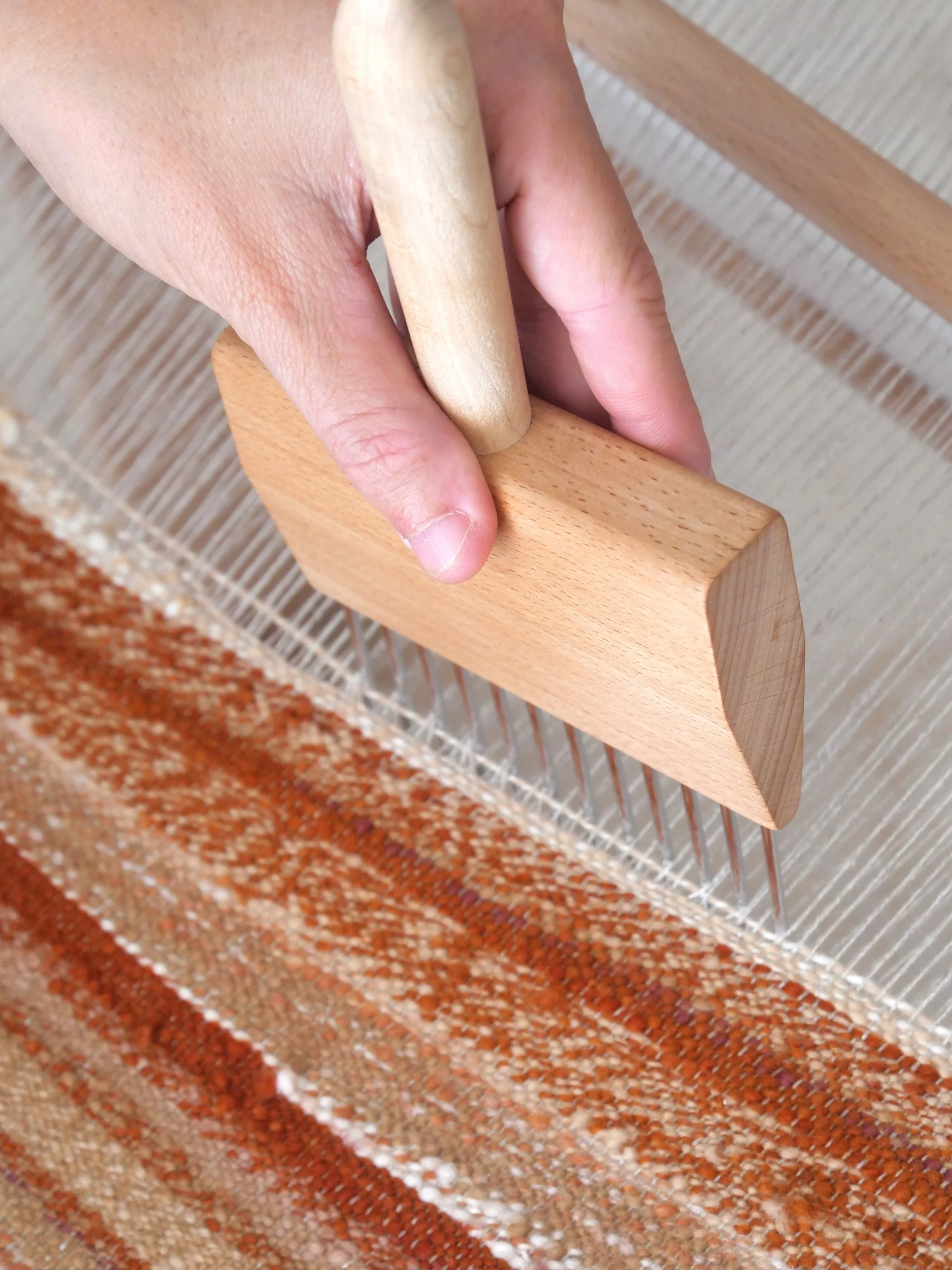
Weaving interests me because what composes the surface is not an image of relation: these are material relations.
Threads cross, stretch, separate and hold one another in place. Air and light pass between them. A local alteration can affect the way the whole structure holds together. A cut can release what was contained and alter the very conditions under which the surface exists.
These phenomena do not “represent” my thinking. They constitute a material territory in which I can put it to the test.
Textile allows me to work with forms that hold together precisely because their elements remain distinct while being embedded in a set of relations.
This relation is not a metaphor.
It is present in the very structure of the weave.
the frame
How can a boundary give form without becoming a closure?
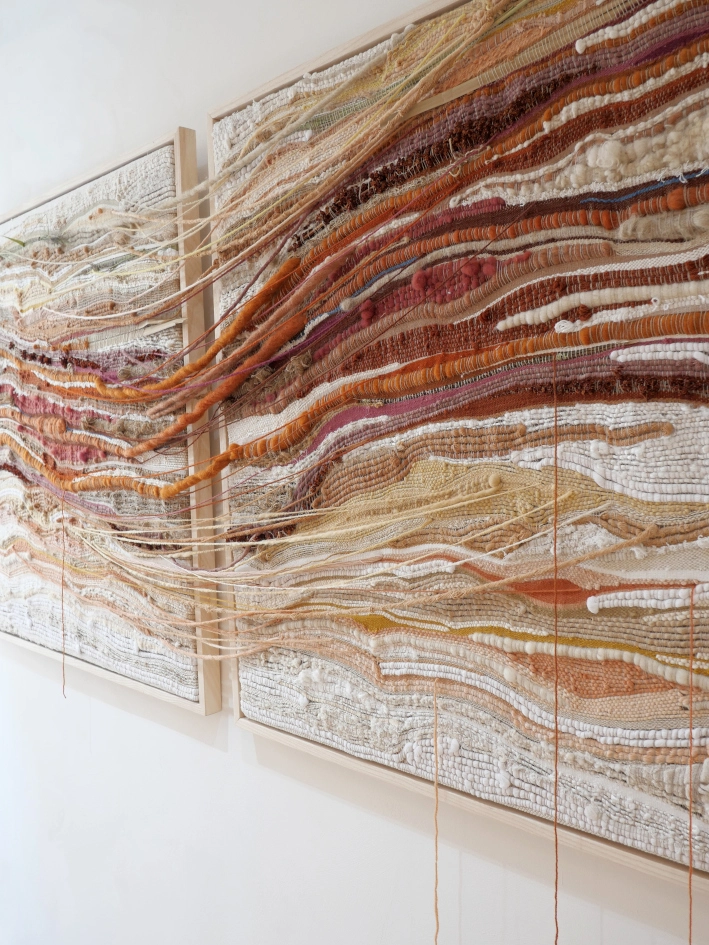
The frame gives the work scale, tension and form. It establishes a real boundary.
This boundary interests me precisely because it does not need to be denied in order to become porous. In some works, the surface remains entirely contained; in others, threads cross the frame, escape it or extend the work into space.
I am not interested in turning the frame into the symbol of a border that should be abolished. A boundary may be necessary for a form to exist. The question, rather, is how it can distinguish without isolating, contain without sealing off.
La question est plutôt de savoir comment elle peut distinguer sans isoler, contenir sans rendre étanche.
A singular form can remain distinct without becoming closed off.
cartographies de l’invisible
The invisible is not a hidden world.
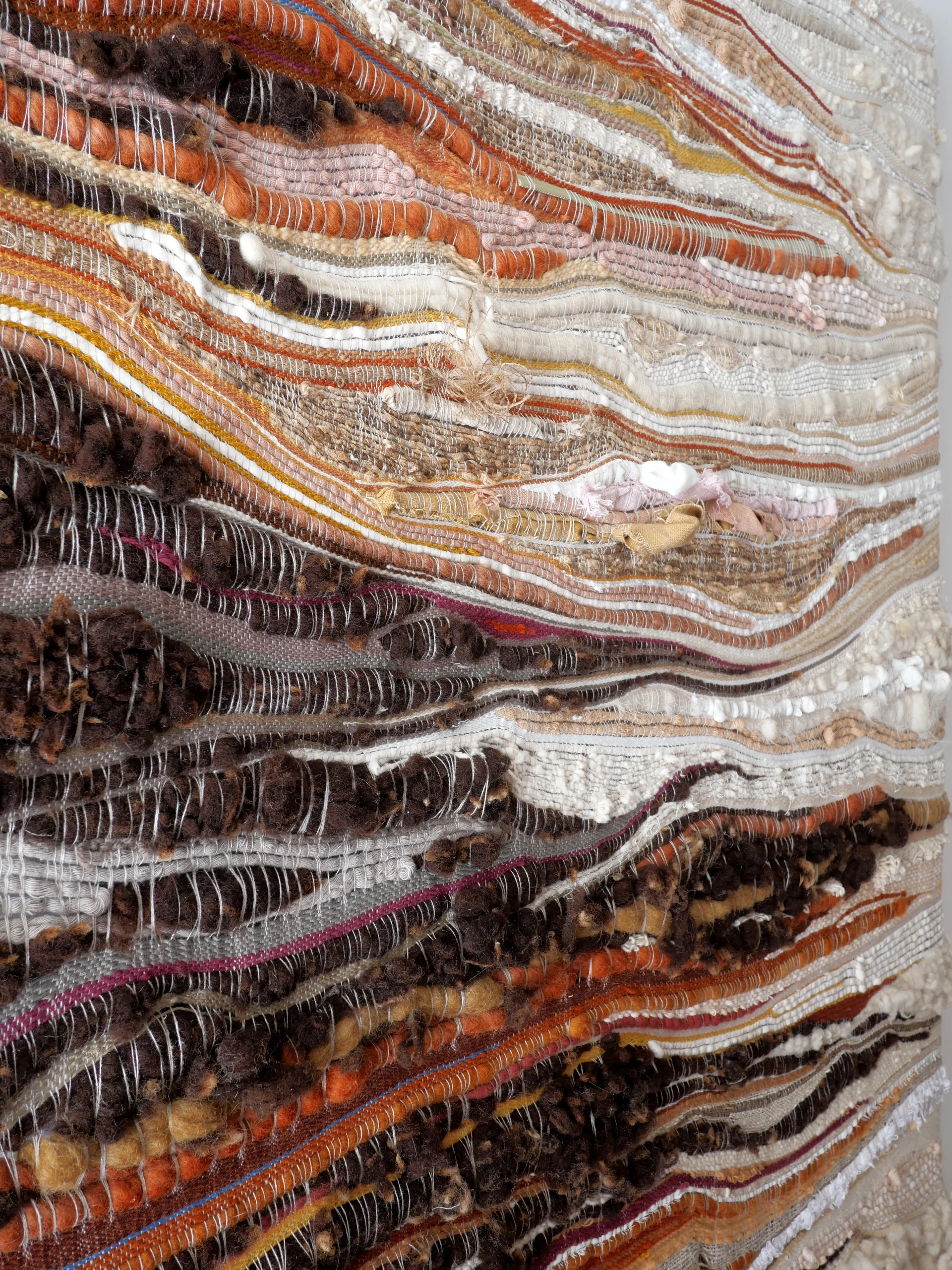
The word cartography comes from my background as a geographer. A map constructs lines in order to make a territory legible. In my work, by contrast, I seek to orient myself from within what I observe, without claiming to encompass it from an outside position.
My Cartographies de l’Invisible represent neither hidden territories, ecosystems, nor networks waiting to be revealed.
The invisible refers instead to what our divisions make less perceptible when they isolate beings, places and times: the passages, transformations and continuities that cross their boundaries.
I construct abstract images made of tensions, openings, intervals and overlaps. Contours can emerge without becoming sealed; threads can enter a surface, emerge from it or continue their movement beyond it.
These forms do not constitute a code. They do not translate my thinking term by term: they are the space in which I work through it.
The surface then becomes a threshold — not towards somewhere else, but towards another way of perceiving what is already there.
WHAT I ASK OF A WORK
I do not expect my works to deliver a message, demonstrate a theory or tell the viewer what to think.
Je ne crois pas davantage qu’une œuvre puisse, à elle seule, transformer notre manière d’habiter le monde.
I hope for something more modest, and perhaps more profound: that it might create the conditions for a certain quality of attention.
A situation in which matter, time, distances, tensions and continuities become present enough for some of the separations we take for granted to become, for a moment, a little less self-evident.