
ARTWORK
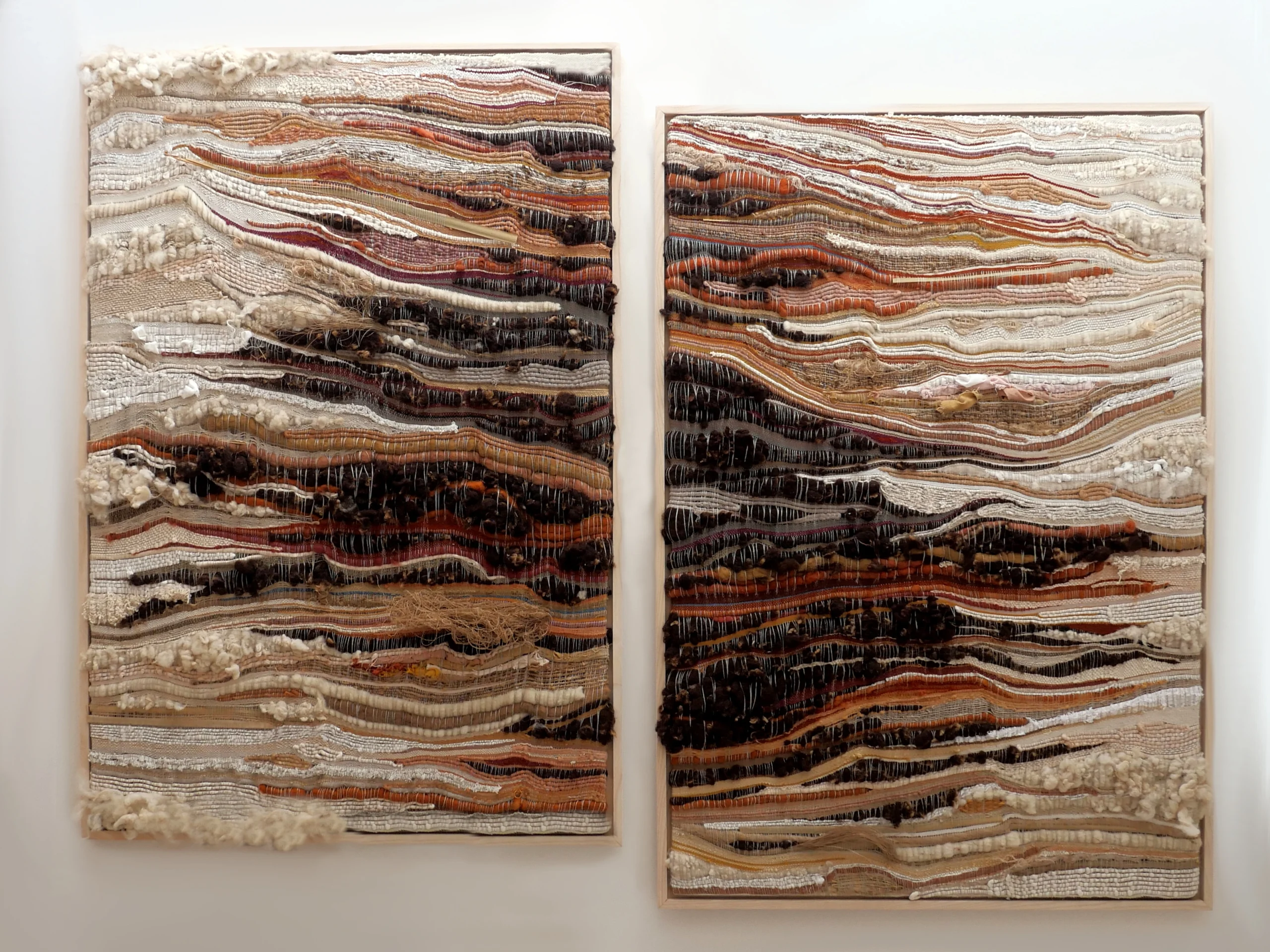
Cartographies de l’Invisible #14
2026
135 x 88 cm
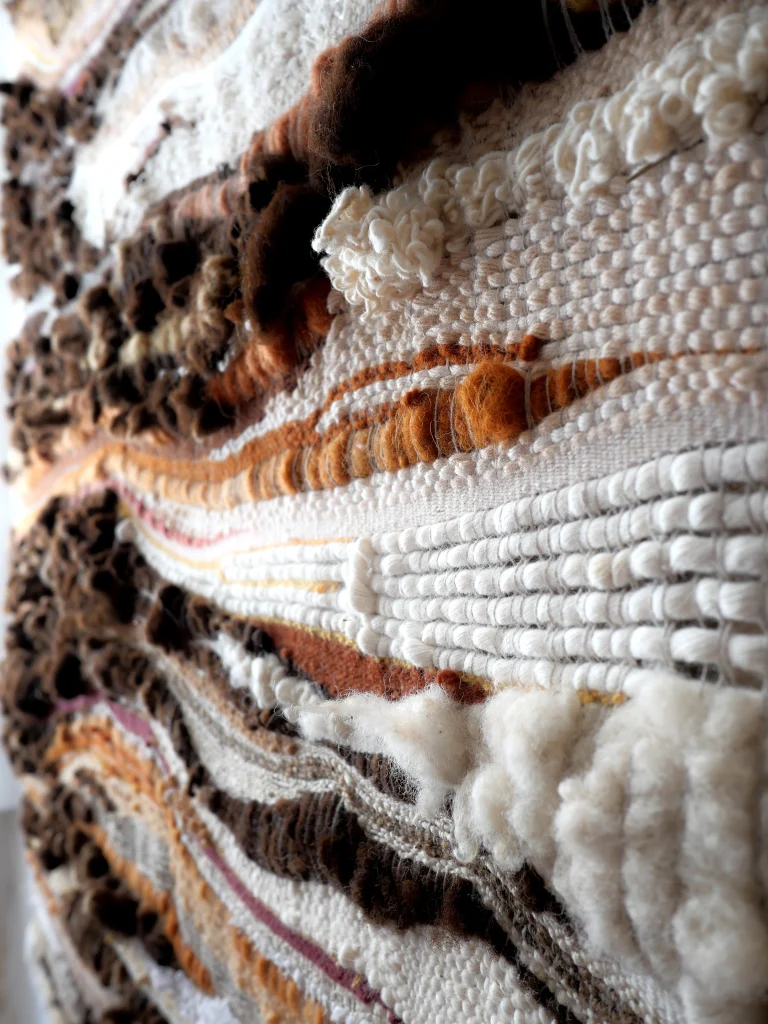
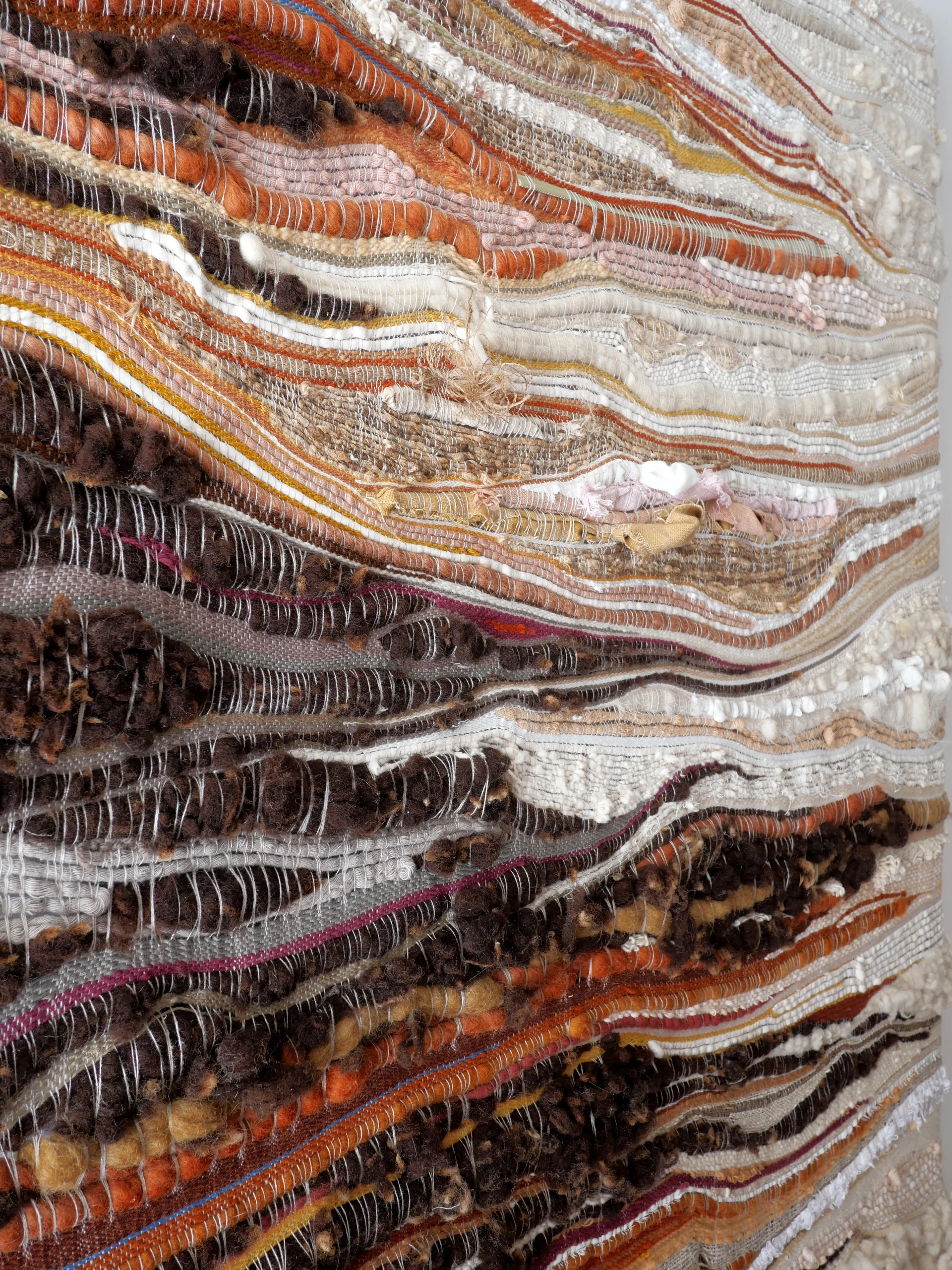
Hand weaving · plant fibres · botanical dyes
Unique work
about the artwork
In Cartographies de l’Invisible #14, two distinct surfaces form a single work without being physically connected to one another.
An empty interval remains between them. No thread crosses it, and no material restores continuity. Yet the lines, colours, densities and movements begun in one panel seem to continue in the other.
An essential part of the work thus takes place in the space where, materially, there is nothing.
The gaze crosses the interval and reconstructs a continuity that the work does not materialise. The separation remains fully visible, yet it is not enough to turn the two surfaces into isolated forms.
What connects the fragments is therefore neither an object added between them nor the symbol of a relation. It emerges through perception, from correspondences that are materially present on either side of the void.
#14 thus explores the possibility that a relation may remain perceptible without being materially continuous: a boundary separates, while the gaze experiences what crosses it.
MATERIALS & TECHNIQUES
what the work is made of
FIBRES
Wools
Mérinos d’Arles — Bouches-du-Rhône · Brigasque — Alpes-Maritimes · Local wool known as “Corde de moine” · White Merino · Black Merino — the latter three from an old stock kept for around twenty years in a cellar in Eygalières before being passed on to me
Cottons
Khadi — Bihar, India; hand-spun · Pakucho — Peru; native naturally coloured variety, undyed · Recycled cotton · Organic cotton grown in Asia and spun in France by an EPV-certified mill
Silks
Naturally copper-coloured Eri · Tassar · Ghicha · Recycled silk · Forest silk
Other plant fibres
Bamboo · Nettle · Hemp · Flax · Banana fibre · Palm fibres
Foraged wild plants
Reed · Rush
Materials may be used in different states — raw, carded, spun, plied, felted or woven — according to their properties and what they make possible within the work.
colours / dyes
Madder · Indigo · Pomegranate · Cosmos · Dyer’s coreopsis · Onion · Avocado · Polypore · Eucalyptus · Osage orange · Chestnut · Alder · Nettle
The dyes are made from plants, fungi, soils and other gathered, recycled or cultivated materials, without commercially produced mineral or metal mordants. Dye baths are used to exhaustion, and residues are composted whenever their nature allows it.
techniques
Hand spinning on a spinning wheel · Natural dyeing · Modification of tannin-rich dyes using fermented iron-rich mud · Hand weaving on a rigid-heddle loom · Incorporation of raw fibres and plant materials · Mounting on a stretcher · Framing and woodworking
frame
Ash · Wood from sustainably managed French forests and worked in the Gard
Pine stretcher
history of the work
What is unique to this work
process
The work was constructed as two distinct surfaces intended to be presented with an interval between them. Unlike Cartographies de l’Invisible #13, no thread physically connects the two panels.
I worked with their lines, densities, materials and colours so that certain continuities could nevertheless be perceived from one fragment to the other. The empty space then becomes active: by crossing it, the gaze continues movements that are materially interrupted by the separation.
At the same time, the palette emerged from research into modifying tannin-rich botanical dyes using the iron contained in iron-rich mud gathered in Les Baux-de-Provence. After fermentation, this mud is used to modify certain fibres that have already been dyed. The reaction between iron and tannins darkens and mutes the colours, shifting them towards the greys and subdued tones characteristic of this piece.
Two phenomena thus meet within the work: a continuity that matter ceases physically to provide between the panels, and colours that themselves emerge through transformation in contact with another material.
exhibitions & awards
Oh My Laine! — Paris Design Week
Galerie Joseph, Paris · 2026
about this work
For any request about this artwork
Availability, exhibition, acquisition or project.